Something strange is happening at Oracle.
Its cloud business is growing ridiculously fast.
Oracle Cloud Infrastructure revenue jumped 121% year over year in its latest quarter. Total cloud revenue reached $11.6 billion. Oracle's remaining performance obligations, basically contracted revenue that has not yet been recognised, climbed to an absurd $664 billion.
Those are not numbers from a company that is dying.
And yet, Oracle is cutting jobs, restructuring teams, spending tens of billions on data centers, issuing stock, carrying more than $100 billion in borrowings, and now one of its biggest AI infrastructure projects is running into trouble.
That project is called Project Jupiter.
And I think Jupiter is interesting for a much bigger reason.
This may be one of the first places where the AI boom is colliding with something AI cannot generate with a prompt: electricity, pipelines, permits, land and money.
01First, what exactly is Stargate?
Remember Project Stargate?
When OpenAI, SoftBank, Oracle and MGX announced Stargate in January 2025, the number attached to it was almost difficult to process: $500 billion.
The plan was to build up to 10 gigawatts of AI infrastructure in the United States, with $100 billion expected to begin deploying immediately.
Oracle became one of the key technology and infrastructure partners. Later, OpenAI and Oracle announced another 4.5 GW of Stargate capacity, enough infrastructure for more than two million chips.
Think about how big that is.
For years, when we talked about software scaling, we meant adding servers, increasing database capacity or spinning up more cloud instances.
AI changed the scale of the conversation. Now we are talking about building things that look less like software projects and more like national infrastructure.
And somewhere inside this giant buildout sits Project Jupiter.
02Project Jupiter looked incredible on paper
Project Jupiter is a massive AI data center campus being built in Doña Ana County, New Mexico.
Oracle is the tenant. The campus is designed to support AI computing, including OpenAI workloads, and its power system alone is planned for up to 2.45 gigawatts of Bloom Energy fuel-cell capacity.
A few months ago Oracle was talking proudly about the project. Thousands of construction workers were already involved. Oracle said the project could create billions of dollars in long-term economic impact for New Mexico.
Then the boring real world arrived.
Power became a problem.
The project depends on enormous amounts of natural gas infrastructure to feed those fuel cells. Permitting and pipeline issues started creating uncertainty.
And in September, Oracle issued a force majeure notice connected to Jupiter.
That phrase sounds like something from a legal drama, but the idea is simple.
Reuters reported that a person familiar with the arrangement expected the project to be delayed by around a year. Oracle and Blue Owl, whose STACK Infrastructure is developing the campus, have maintained that the parties remain committed to the project.
So no, Project Jupiter has not been cancelled. That distinction matters.
But the fact that we are even talking about force majeure on one of the biggest AI infrastructure projects in America tells us something.
Building AI is becoming a lot harder than buying GPUs.
03The real Oracle story is hiding in its cash flow
This is where things became much more interesting to me.
Because if you only look at Oracle's revenue numbers, everything looks fantastic.
Cloud infrastructure revenue up 121%. A $664 billion backlog. More than 300,000 GPUs delivered to customers since the previous quarter. AI demand apparently growing faster than Oracle can provide capacity.
Beautiful.
Then you open the cash-flow statement.
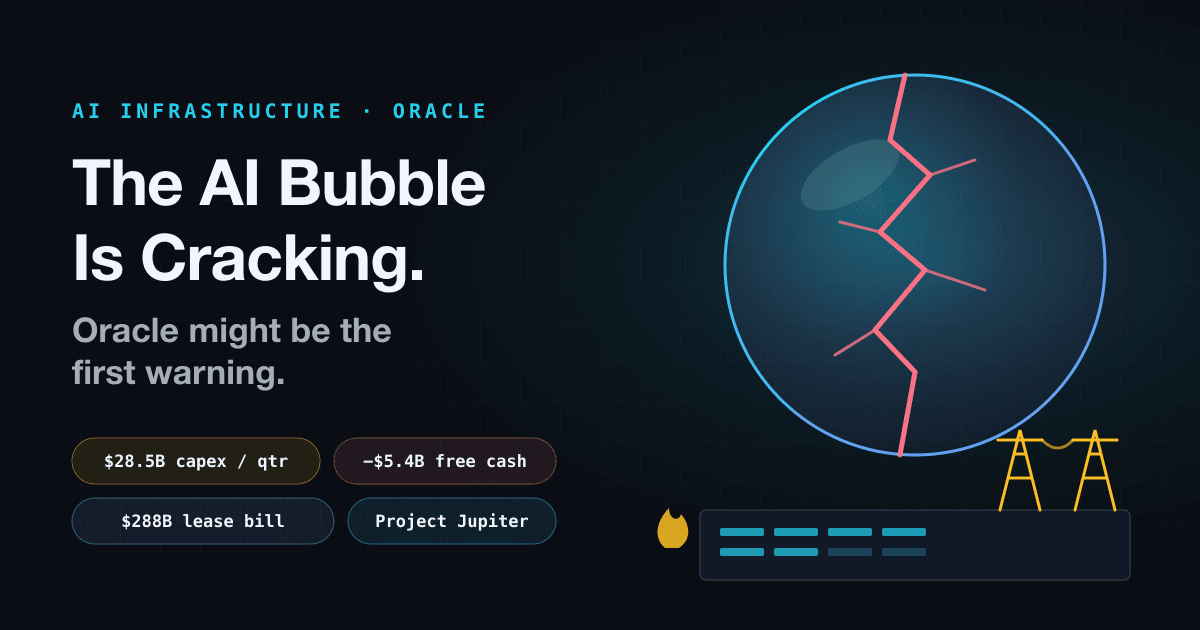
Oracle spent $28.5 billion on capital expenditure in just the first quarter of fiscal 2027. A year earlier, the same number was $8.5 billion.
Operating cash flow was extremely strong at $23.1 billion, but the infrastructure spending was even bigger.
Result? Free cash flow: negative $5.4 billion. And that came after Oracle reported negative $23.7 billion in free cash flow for fiscal 2026.
This is the part of the AI boom I find fascinating.
The revenue is real. The demand is real. But so is the bill.
04And then I saw the $288 billion number
This one genuinely made me stop reading for a second.
Oracle's August 2026 filing says the company had approximately $288 billion in additional lease commitments. Most of those commitments relate to data centers.
They are expected to begin between fiscal 2027 and 2029, generally running for 15 to 19 years. And importantly, those commitments were not yet reflected in the lease-liability table on Oracle's balance sheet because the leases had not started.
Oracle also reported around $125 billion of senior notes and other long-term borrowings as of August 31.
Now you can see the gamble. Oracle is essentially saying:
AI demand will become so large that all this capacity will eventually be required.
And it may be right.
But if growth slows, AI models become dramatically more efficient, customers reduce spending, competitors undercut pricing, or infrastructure sits idle longer than expected, these commitments do not magically disappear.
AI suddenly becomes a very expensive game.
05Which brings us to the layoffs
This is also why I do not think Oracle's layoffs should be looked at separately from the AI story.
Oracle had around 162,000 employees in May 2025. One year later, that number had fallen to approximately 141,000. That is a reduction of roughly 21,000 employees, or 13% of the workforce.
Oracle spent about $1.84 billion on restructuring and related costs during fiscal 2026. Its own filing says the restructuring included operational-efficiency measures and the adoption and integration of AI technologies.
And it did not stop there. In September, Oracle disclosed that it had added another $700 million to its restructuring plan, bringing estimated restructuring costs to roughly $2.8 billion.
Another reported round affected 546 employees inside Oracle's America Cloud Infrastructure organisation, including developers, program managers, engineers and data-center support staff.
That combination feels brutal.
The cloud division is growing. AI contracts are arriving. Oracle needs more infrastructure than ever. And employees are still being removed.
But financially, the logic is not difficult to understand.
When billions of dollars are being redirected toward GPUs, buildings, power infrastructure and long-term data-center leases, management starts looking very aggressively at every other cost. Payroll is one of the biggest.
So when companies say AI will make the organisation “more efficient”, sometimes that means better software.
Sometimes it also means fewer people.
06So... is the AI bubble finally cracking?
I would not go that far. Not yet.
Calling the whole thing a bubble ignores something important: Oracle is actually selling a lot of AI compute.
OCI infrastructure revenue is not hypothetical. It grew 121%. The backlog is not a PowerPoint slide. Oracle says it has hundreds of billions in remaining performance obligations.
OpenAI needs absurd amounts of compute. Meta needs it. xAI needs it. Nvidia needs somewhere for all those chips to run.
Demand is clearly there.
What Project Jupiter exposes is something slightly different.
The AI software revolution has a physical infrastructure problem.
You can improve a model every few months. You cannot build a 2.45 GW power system every few months.
You cannot autocomplete a natural gas pipeline. You cannot npm install a power grid.
And GitHub Copilot is unfortunately still unable to approve an environmental permit.
This is where the AI race becomes a construction, financing, energy and political problem.
07Jupiter might be more important than Jupiter
The most interesting thing about this story is not whether one New Mexico data center opens in 2027 or 2028.
It is what happens if the same problem appears everywhere.
Reuters reported that AI infrastructure investors and lenders are already asking harder questions about how risks are shared when enormous projects get delayed. The same report noted that projects worth tens of billions of dollars have faced community opposition this year.
And these projects are becoming unbelievably large.
Everything works beautifully while utilisation keeps increasing.
But when projects cost tens of billions of dollars, even a one-year delay matters. Interest keeps running. Investors still want returns. Equipment gets financed. Lease commitments remain.
That is where cracks become expensive.
08The weird part is that Oracle may still win
And this is why this story is more complicated than “Oracle is in trouble.”
Oracle may have made one of the smartest bets in its history.
For decades, AWS, Microsoft and Google dominated cloud infrastructure. AI created a rare reset.
Suddenly companies did not only care about who had the most mature cloud platform. They needed GPUs. Immediately.
Oracle had capacity, Nvidia relationships, aggressive pricing and the willingness to build infrastructure at an enormous scale.
It worked. OCI is now growing faster than anyone would have expected from Oracle a few years ago.
But Oracle is paying for that opportunity upfront. A lot of the revenue comes later. The data centers have to be built now.
Which makes this less like selling software and more like building railways. Massive capital first. Hopefully enormous economic activity later.
09My takeaway
I do not think Project Jupiter proves that the AI bubble has burst.
I think it shows us where the bubble would crack if the economics stop working.
The biggest risk may not be that nobody wants AI. People clearly do.
The risk is that the industry builds infrastructure based on expectations that are so enormous that even incredible AI growth struggles to catch up with the money already committed.
Oracle now has booming cloud revenue, hundreds of billions in contracted business and some of the strongest AI infrastructure demand in the world.
It also has negative free cash flow, huge borrowings, massive future data-center lease commitments, continued restructuring and an AI campus dealing with the very unglamorous problem of getting enough energy.
Those two versions of Oracle exist at the same time. And maybe that is the best picture of the AI industry in 2026.
A prompt goes in. An answer appears. Somewhere behind that tiny text box are GPUs, cooling systems, buildings, debt, power plants, pipelines, construction workers and billions upon billions of dollars.
We spent the last three years asking one question. I think the next one is going to be much less exciting.
Project Jupiter may be one of the first serious tests.
Not the end of the AI boom.
But definitely a reminder that eventually, even artificial intelligence has to pay the electricity bill.